If you’re planning to bring a loved one to the United States, one of your first and most important decisions will be choosing the right visa pathway. Two of the most common options — the fiancé(e) visa and the family-based visa — are often confused. Still, they serve very different purposes and come with distinct requirements, timelines, and costs. This guide breaks down exactly how each works so you can determine which one fits your situation.
The Key Difference, Upfront
The simplest way to understand the distinction:
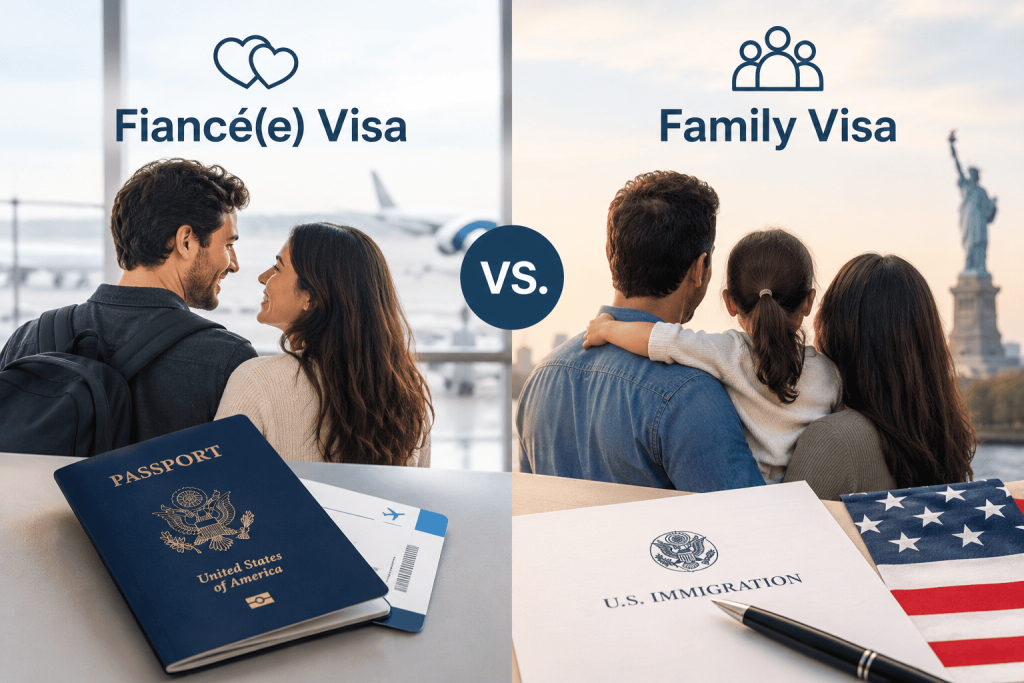
- Fiancé(e) visa (K-1): For couples who are engaged but not yet married, allowing the foreign fiancé(e) to enter the U.S. specifically to get married within 90 days.
- Family visa (CR-1/IR-1): For couples who are already legally married, allowing the foreign spouse to enter the U.S. with immigrant status from the start.
In short: if you’re not yet married, you’re likely looking at a K-1 visa. If you’re already married, you’ll pursue a spousal immigrant visa instead.
Understanding the Fiancé(e) Visa (K-1)
The K-1 visa is designed for U.S. citizens who are engaged to a foreign national and wish to bring them to the U.S. to get married. It is not available to permanent residents (green card holders) — only U.S. citizens can sponsor a fiancé(e).
How the K-1 Process Works
- File Form I-129F (Petition for Alien Fiancé(e)) with USCIS, including proof of a genuine relationship and intent to marry.
- USCIS approval, after which the petition is forwarded to the National Visa Center and then the U.S. embassy or consulate in your fiancé(e)’s home country.
- Visa interview at the consulate, where the fiancé(e) must demonstrate the relationship is legitimate and that both parties intend to marry.
- Entry into the U.S. on the K-1 visa, valid for a single entry within 90 days.
- Marriage within 90 days of entry — this is a strict legal requirement.
- Adjustment of status — after the wedding, the foreign spouse files Form I-485 to become a permanent resident (green card holder).
Important Requirements
- You must have met your fiancé(e) in person within the last two years (limited exceptions apply for cultural or religious reasons).
- You must provide evidence of a bona fide relationship — photos, communication records, travel history together, etc.
- Both parties must be legally free to marry (any prior marriages must be properly terminated).
Timeline and Cost
The K-1 process typically takes 9–14 months from filing to visa issuance, though this can vary based on USCIS processing times and consulate workloads. After marriage, the adjustment of status process adds additional months before the green card is issued.
Understanding the Family Visa (Spousal/CR-1-IR-1)
If you’re already married, your spouse would apply through the family-based immigrant visa process instead. This path leads directly to permanent residency, without the intermediate K-1 and adjustment-of-status steps.
How the Family Visa Process Works
- File Form I-130 (Petition for Alien Relative) with USCIS to establish the qualifying marital relationship.
- USCIS approval, after which the case moves to the National Visa Center for document collection and fee payment.
- Consular interview at the U.S. embassy or consulate in the spouse’s home country.
- Visa issuance — if approved, the spouse receives an immigrant visa and can travel to the U.S.
- Entry as a permanent resident — upon arrival, the spouse becomes a conditional or full permanent resident immediately (no separate adjustment-of-status filing needed if processed abroad).
CR-1 vs. IR-1: What’s the Difference?
- CR-1 (Conditional Resident): Issued when the couple has been married less than two years at the time of approval. The spouse receives a 2-year conditional green card and must file Form I-751 to remove conditions before it expires.
- IR-1 (Immediate Relative): Issued when the couple has been married more than two years. The spouse receives a 10-year green card immediately, with no conditional period.
Timeline and Cost
Spousal visa processing typically takes 12–18 months, depending on the embassy or consulate handling the case. Because there’s no K-1-to-marriage-to-adjustment sequence, the overall timeline to permanent residency is often more streamlined than the fiancé(e) pathway — though total time can still vary significantly by country.
Side-by-Side Comparison
| Factor | K-1 Fiancé(e) Visa | Spousal Visa (CR-1/IR-1) |
| Marital status required | Engaged, not yet married | Already legally married |
| Sponsor eligibility | U.S. citizens only | U.S. citizens and green card holders |
| Initial status in U.S. | Nonimmigrant (90 days) | Immigrant (permanent resident) |
| Additional filing after entry | Yes — marriage + Form I-485 | No (if processed abroad) |
| Total process time | 9–14 months + adjustment period | 12–18 months |
| Flexibility | Must marry within 90 days or leave | No marriage deadline (already married) |
Which One Should You Choose?
The honest answer: your current relationship status decides this for you.
- If you are engaged but not married, and you (the sponsor) are a U.S. citizen, the K-1 fiancé(e) visa is your pathway.
- If you are already legally married, the spousal immigrant visa (CR-1/IR-1) is the correct route — regardless of whether the sponsor is a citizen or green card holder.
One nuance worth considering: if you’re engaged and your sponsor is a green card holder (not a citizen), the K-1 visa isn’t available to you at all. In that case, some couples choose to marry first — either in the U.S. or abroad — so they can pursue the spousal visa pathway instead, which permanent residents can use to sponsor a spouse.
Common Mistakes in Both Processes
- Insufficient evidence of a genuine relationship — Both visa types require convincing proof that the relationship is authentic, not entered into for immigration purposes.
- Missing the 90-day marriage deadline (K-1 only) — Failing to marry within this window means the fiancé(e) must leave the U.S. or risk falling out of status.
- Incomplete or inconsistent documentation — Discrepancies between forms, interviews, and supporting evidence are a leading cause of delays and denials.
- Not preparing for the conditional green card removal (CR-1 only) — Couples married less than two years must remember to file Form I-751 before the conditional card expires, or risk losing status.
- DIY filing without understanding nuances — Both processes involve strict documentation and legal standards that are easy to get wrong without guidance.
Why Professional Guidance Matters
Both the fiancé(e) visa and family visa processes involve multiple government agencies, strict evidentiary standards, and firm deadlines. A single missing document or inconsistency in your application can lead to months of delay — or an outright denial. An experienced immigration attorney can help you:
- Determine which visa pathway truly fits your situation
- Prepare a strong, well-documented petition from the start
- Navigate the National Visa Center and consular interview process
- Avoid common pitfalls that lead to Requests for Evidence (RFEs) or denials
- Handle the adjustment of status or conditional residency removal steps correctly
Get Matched With a Trusted Immigration Attorney
Whether you’re planning to marry your fiancé(e) in the U.S. or bringing your spouse home through the family visa process, having the right legal guidance can save you months of stress and costly mistakes.
Find a verified immigration attorney in your state through our Immigration Lawyers Directory to get personalized guidance on which visa pathway is right for your relationship — and support through every step of the process.